

TL;DR:
- Getting novelty item pricing wrong can significantly impact profit margins for UK retailers and event organizers. Profitability depends on accurate cost calculations, strategic pricing, and ongoing monitoring, especially since impulse buys thrive on perceived value rather than utility. Consistently reviewing sales data, adjusting prices proactively, and sourcing affordable stock are key to maintaining healthy margins and successful sales.
Getting the price wrong on novelty items is one of the easiest and most costly mistakes a UK retailer or event organiser can make. Price too low and you’re practically giving your margin away. Price too high and you’re left staring at a box of unsold toys after the school fair. Neither feels great, and both eat into the time, money, and effort you’ve put in. This guide walks you through the exact methods used by profitable UK sellers and event teams to price bulk novelty goods with confidence, covering everything from basic cost calculations right through to smart presentation tactics and markdown planning.
Table of Contents
- Understand the essentials of novelty item pricing
- Step-by-step: Calculating your unit price and wholesale price
- Event pricing: Prizes, bundles, and tiered reward structures
- Maximise profit with smart price presentation and markdown strategies
- The real secret to pricing novelty items profitably
- Partner with the UK’s trusted wholesale novelty supplier
- Frequently asked questions
Key Takeaways
| Point | Details |
|---|---|
| Start with true costs | Always include all direct and overhead costs before applying any markup or margin. |
| Model wholesale and retail separately | Differentiate between your wholesale and retail pricing to protect margins at each stage. |
| Structure event prizes in tiers | Match prize value to perceived participant motivation and budget control using tiered options. |
| Present prices with intent | Use psychological pricing tactics like charm pricing judiciously and test for their actual impact. |
| Plan markdowns in advance | Define early discount triggers based on sell-through to protect total margin and clear dead stock smartly. |
Understand the essentials of novelty item pricing
Before you set a single price, you need to understand what makes novelty item pricing different from, say, pricing a pair of jeans or a box of cereal. Novelty toys are impulse buys. They succeed on energy, excitement, and perceived value, not on utility. That means pricing psychology plays a bigger role here than in almost any other product category.
The most reliable starting point is the cost-plus pricing method: add together all relevant costs, including your cost of goods sold and any fixed or variable overheads, and then apply your desired profit margin on top. Simple in theory. The tricky part is making sure you’ve captured every cost before you start marking up.
Here’s what you must include in your cost calculation:
- Product cost per unit (the wholesale price you paid, divided by quantity)
- Packaging (bags, labels, tissue paper, boxes)
- Postage and shipping (inbound delivery from supplier)
- Storage and handling (your time and space aren’t free)
- Platform or marketplace fees (market stall fees, online listing costs)
- Shrinkage and breakage (a small percentage for damaged or missing stock)
That last one catches people out repeatedly. If you’re selling fun snaps or small plastic toys in bulk, a few will inevitably be broken or lost before they reach a customer. Build that in from day one.
Before you dive into the numbers, check out our market stall toys guide for a practical overview of which novelty lines sell best at UK retail setups.
Here’s a quick reference table to help you map out your cost elements:
| Cost element | What to include | Typical range |
|---|---|---|
| Product cost | Wholesale unit price | Varies by volume |
| Packaging | Bags, labels, wrapping | £0.02 to £0.15 per unit |
| Inbound shipping | Freight or courier cost per unit | £0.05 to £0.20 per unit |
| Overheads | Stall fees, storage, platform costs | Allocate a fixed % |
| Shrinkage allowance | Estimated breakage or loss | 2% to 5% of stock value |
Pro Tip: Always calculate your “landed cost per unit” before setting any markup. That means adding up everything it took to get one item into your hand, ready to sell. Many sellers forget inbound shipping and then wonder why their margins look thin at the end of the month.
Step-by-step: Calculating your unit price and wholesale price
Right then, let’s get practical. Here is a clear workflow you can follow whether you’re a market stall retailer, a school fundraising coordinator, or a toy shop owner buying in bulk.
-
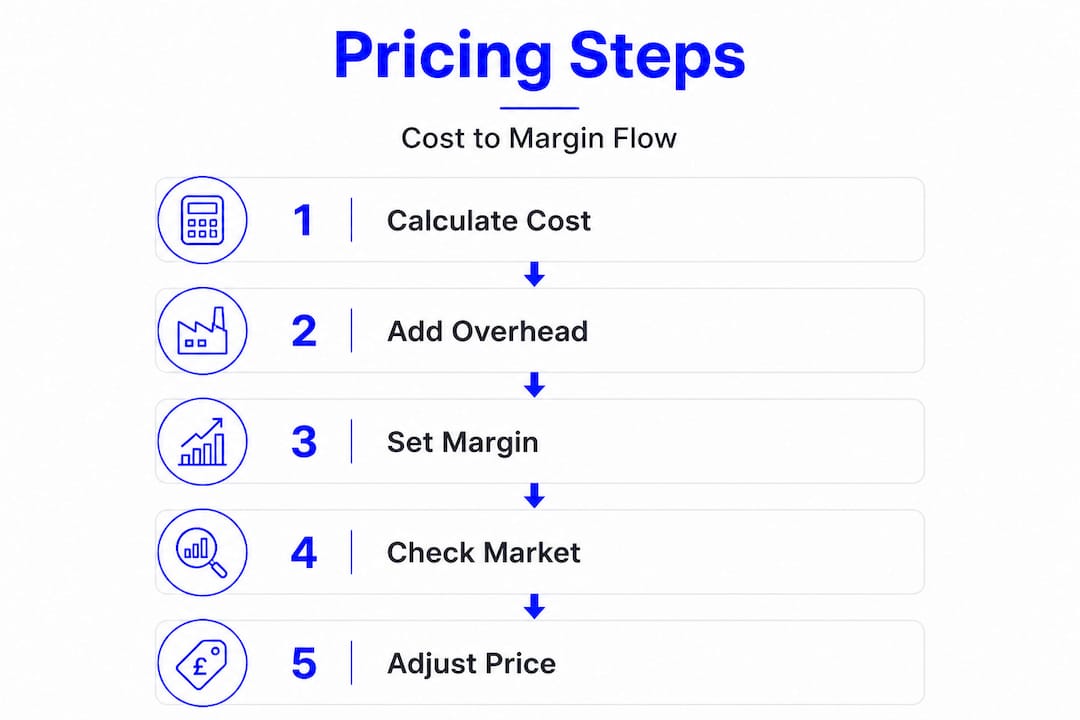
Tally every cost. Start with your invoice price from your wholesale supplier. Add packaging, your share of inbound delivery, storage, and any fees related to selling (stall hire, online listing fees). Include a 3% shrinkage buffer as a standard practice.
-
Decide your target margin. Wholesale profit margins for novelty and toy products typically range between 15% and 50%, depending on competition, volume, and the strength of your sales channel. For event-based retail or market stalls, aiming for 40% to 50% gross margin is both achievable and sensible. For wholesale resale (you supplying other traders), 20% to 35% is more typical.
-
Calculate your minimum viable price. The formula is: Selling price = Total cost per unit / (1 minus desired margin). So if your total cost per unit is £0.40 and you want a 50% margin, your minimum selling price is £0.40 / 0.50 = £0.80 per unit.
-
Set your retail price above minimum. Don’t just sell at minimum. Give yourself room to run promotions, bundle deals, or offer the occasional discount without wiping out your margin.
-
Add presentation tactics only after unit economics work. Bundle pricing, charm pricing, and tiered offers are finishing touches. Get the maths right first. As part of a practical pricing workflow, charm pricing and bundle offers should only come after your unit economics are solid.
Here’s an example calculation table to make this real:
| Item | Wholesale unit cost | Packaging | Shipping per unit | Shrinkage (3%) | Total cost | Target margin (50%) | Retail price |
|---|---|---|---|---|---|---|---|
| Fun snaps pack | £0.18 | £0.03 | £0.05 | £0.01 | £0.27 | 50% | £0.54 |
| Stretchy toy | £0.22 | £0.04 | £0.05 | £0.01 | £0.32 | 45% | £0.58 |
| Party bag filler set | £0.35 | £0.05 | £0.06 | £0.01 | £0.47 | 50% | £0.94 |
When it comes to sourcing, good margins start with smart buying. Our toy sourcing tips and novelty toy wholesale workflow are worth a read before you place your next order. Getting your costs down at the buying stage is the single fastest way to improve your margins at the selling stage.
Remember: when you’re separating wholesale from retail price, model both clearly. Your wholesale price to a stockist should still carry a healthy margin for you, even before their retail markup is applied.
Event pricing: Prizes, bundles, and tiered reward structures
Now let’s talk about the event world, because prize and novelty pricing for fundraisers, school fairs, and competitions works quite differently from standard retail.
Here’s the key insight: event attendees don’t think in cost terms. They think in excitement terms. A £0.50 toy that looks impressive, lights up, or makes noise can feel like a £3 prize to an eight-year-old on a sugar high at a summer fete. That’s your opportunity.

Rather than pricing prizes based purely on what they cost, structure prizes in tiers to match different participation levels and engagement goals. A small participation prize, a mid-tier reward for placing well, and a standout top prize each serve a different purpose and should be budgeted and priced accordingly.
For fundraising events in particular, work backwards from your goals. If you need to raise £500 from a raffle, and your ticket price is £1, you need 500 ticket sales. Now ask: what prize value would motivate 500 people to buy a ticket? That question should drive your prize budget, not the other way around.
Here’s a handy comparison table for structuring prize tiers at events:
| Prize tier | Example item | Typical cost per item | Perceived value | Best use |
|---|---|---|---|---|
| Participation (small) | Fun snaps, sticker sheets | £0.15 to £0.40 | £0.50 to £1.50 | Everyone gets one |
| Mid-tier reward | Stretchy figures, wind-up toys | £0.40 to £1.00 | £1.50 to £3.00 | Top finishers, runners-up |
| Top prize | Plush toy, activity kit | £2.00 to £5.00 | £5.00 to £15.00 | Raffle top prize, winner |
Before you finalise your event prize pricing, ask yourself these questions:
- What’s the total prize budget as a percentage of expected event revenue?
- Does the top prize feel exciting enough to motivate ticket purchases or game plays?
- Are the participation prizes good enough to delight a child without blowing your budget?
- Have you factored in the number of prizes needed across all tiers?
- Is your prize selection appropriate for the age range attending?
Pro Tip: Higher perceived value almost always beats lowest cost when it comes to event ROI. A slightly more expensive top prize that generates buzz and drives ticket sales will outperform a cheap one that nobody cares about. Spend a little more where it counts, and save money on participation prizes through bulk buying.
Our event prize toy ideas page has a great selection of items that punch well above their price tag in terms of visual appeal and excitement.
Maximise profit with smart price presentation and markdown strategies
You’ve done the maths. Now let’s talk about how you present those prices, because the number itself is only half the story.
Charm pricing, that classic trick of pricing something at £0.99 instead of £1.00, can work beautifully for novelty items. But charm pricing must be tested and used sparingly. Overuse it and customers start to notice. It can actually undermine trust in premium or gift-style novelty lines where a round price feels more confident and credible.
Here are three common price presentation mistakes to avoid:
- Pricing everything at £0.99: It feels dated on market stalls and can make your whole range look cheap rather than cheerful.
- Copying a competitor’s price without knowing their actual sales data: What someone else lists a product at tells you very little about what it actually sells for.
- Ignoring bundle pricing: Selling three items for £1.50 instead of £0.59 each often increases both units sold and total revenue per transaction.
“Beware relying on arbitrary benchmark listings without checking actual sell-through data. Online list prices can differ wildly from what actually sells at a given time.”
When it comes to markdowns, the golden rule is: early and shallow beats late and deep. If a line isn’t shifting after two or three weeks, a 10% to 15% price reduction now will recover far more total margin than a 40% slash at the end of the season. Markdown as a planned process tied to sell-through thresholds is what separates professional sellers from those stuck with dead stock.
Understanding why cheap toys attract customers is a useful lens here. It’s not just about the low price point. It’s about the perceived value at that price. And that perception is something you can actively shape through presentation, bundling, and smart display.
Pro Tip: Run a simple A/B test on your stall or online shop. Price a batch at £0.99 and another identical batch at £1.00 across different sessions. Track which converts better. Real data from your actual customers beats any pricing theory every time. You can learn more about maximising returns in our resale toy profit guide and find safety-compliant stock in our safe novelty wholesale sourcing guide.
The real secret to pricing novelty items profitably
Here’s the thing nobody really talks about. Every formula, every table, every step-by-step guide in this article, including this one, is only as good as the data you feed into it and how regularly you update it.
The sellers who consistently make strong margins on novelty items aren’t necessarily the ones with the lowest sourcing costs or the cleverest psychological pricing tricks. They’re the ones who treat pricing as a living process rather than a one-time decision. They check what’s selling each week. They spot slow movers early. They test prices, track results, and adjust without drama.
Most struggling sellers do one of two things: they set prices once and forget them, or they obsessively chase what competitors are listing online without ever knowing whether those competitors are actually profitable. Neither approach works long-term.
The profitable approach looks more like this. You set your initial price based on real cost data, as outlined above. You track sell-through weekly or after each event. You trigger markdowns based on pre-defined thresholds, not panic. And every few months, you revisit your cost base to account for changes in shipping, supplier pricing, or event fees.
As we cover in detail when streamlining your pricing workflow, building these habits into your routine makes the whole process less stressful and far more profitable over time.
Successful pricing isn’t a set-and-forget job. It’s an ongoing process rooted in real sales data and timely markdown triggers. The retailers and event organisers who thrive are the ones who treat their pricing like a garden. Tend it regularly, and it flourishes. Leave it alone, and the weeds take over.
Partner with the UK’s trusted wholesale novelty supplier
Now that you’ve got the pricing knowledge, the next piece of the puzzle is sourcing stock that supports those margins from day one.
At TC Toys, we supply CE and UKCA-marked novelty toys and bulk party items to retailers, PTAs, market traders, and event organisers across the UK. Fast fulfilment, no minimum order requirements, and consistently low wholesale prices mean your unit cost stays low and your margins stay healthy. Whether you’re stocking up for a school fair, a fundraising raffle, or a market stall, explore our PTA wholesale toys range or browse hundreds of options in our party bag toy supplies collection. Your next profitable event starts here.
Frequently asked questions
What is a typical profit margin for novelty items in UK retail?
Profit margins for novelty items typically range from 15% to 50%, with market stall and event-based retail often achieving the higher end of that range due to impulse buying behaviour.
How do I set the value of prizes for fundraising events?
Base your prize value on event goals, audience expectations, and a tiered reward structure, as structuring prizes in tiers helps match participant experience to your available budget without overspending on every prize.
Should I use .99 pricing for novelty items?
Charm pricing like £0.99 can boost conversions but works best used selectively, as overuse can erode trust or make your range feel low-quality rather than great value.
What if my novelty items are not selling?
Plan for early, shallow discounts triggered by sell-through data, because early, shallow markdowns recover more total margin than waiting and then cutting prices deeply at the end of the season.
How can I avoid pricing mistakes with bulk novelty items?
Rely on your own real sales data rather than copying competitor listings, and review your prices regularly based on actual sell-through results rather than assumptions.