

TL;DR:
- UK toy safety regulations mandate strict compliance with EN71 standards and UKCA or CE markings.
- Retailers should verify documentation, labels, and physical safety features before sourcing toys.
- Many toys from online marketplaces fail safety tests, increasing risks for children and reputational damage for sellers.
Choosing toys for retail or events feels straightforward until you realise the weight of responsibility sitting on your shoulders. Get it wrong and you’re not just dealing with a complaint, you’re facing potential legal action, product recalls, and a reputation that takes years to rebuild. The UK Toys (Safety) Regulations 2011 require every toy sold to children under 14 to meet rigorous mechanical, chemical, flammability, and electrical safety standards. That’s a lot to keep track of, especially when you’re buying in bulk for a busy market stall, school fair, or retail shop. This checklist is here to make that process far less daunting, and a great deal more confident.
Table of Contents
- Key safety standards for UK retail toys
- How to evaluate toy safety and suitability
- Common pitfalls and safety risks to avoid
- Final checklist for bulk purchases and events
- A retailer’s perspective: Beyond compliance, why safety is your brand
- Find safer, more compliant wholesale toys with TC Toys
- Frequently asked questions
Key Takeaways
| Point | Details |
|---|---|
| Always check safety marks | Every toy must have a visible UKCA or CE mark and comply with EN71 standards to be legally sold in the UK. |
| Assess for age and context | Choose toys suited to the target age group and setting, especially watching for small parts or battery security for young children. |
| Be wary of online sourcing | Most toys from online marketplaces fail official safety tests, making bulk purchasing from reputable suppliers essential. |
| Use a full checklist approach | Work through a comprehensive selection checklist for each order to protect children, meet your duties, and safeguard your business. |
Key safety standards for UK retail toys
Understanding legal and safety requirements is the necessary foundation for any toy selection process. You can’t make good buying decisions if you don’t know the rules, and the rules here are genuinely serious.
Every toy sold or distributed in Great Britain must carry a UKCA or CE mark. These aren’t just stickers. They signal that a toy has been tested and assessed against the UK’s essential safety requirements. If you want to understand the meaning of CE and UKCA marks in plain English, it’s worth a read before you place your next order. Similarly, our guide on UKCA certification for toys breaks down exactly what to look for on packaging.
The EN71 standards are the technical benchmarks toys must meet. These cover everything from how small a part can be before it becomes a choking hazard, to how much of a chemical element can migrate from a painted surface. And they’re being updated. EN71-3:2019+A2:2024 and EN71-13:2021+A2:2024 are now in effect for 2026, tightening limits on chemical migration and adding new requirements for toys that stimulate smell or taste.
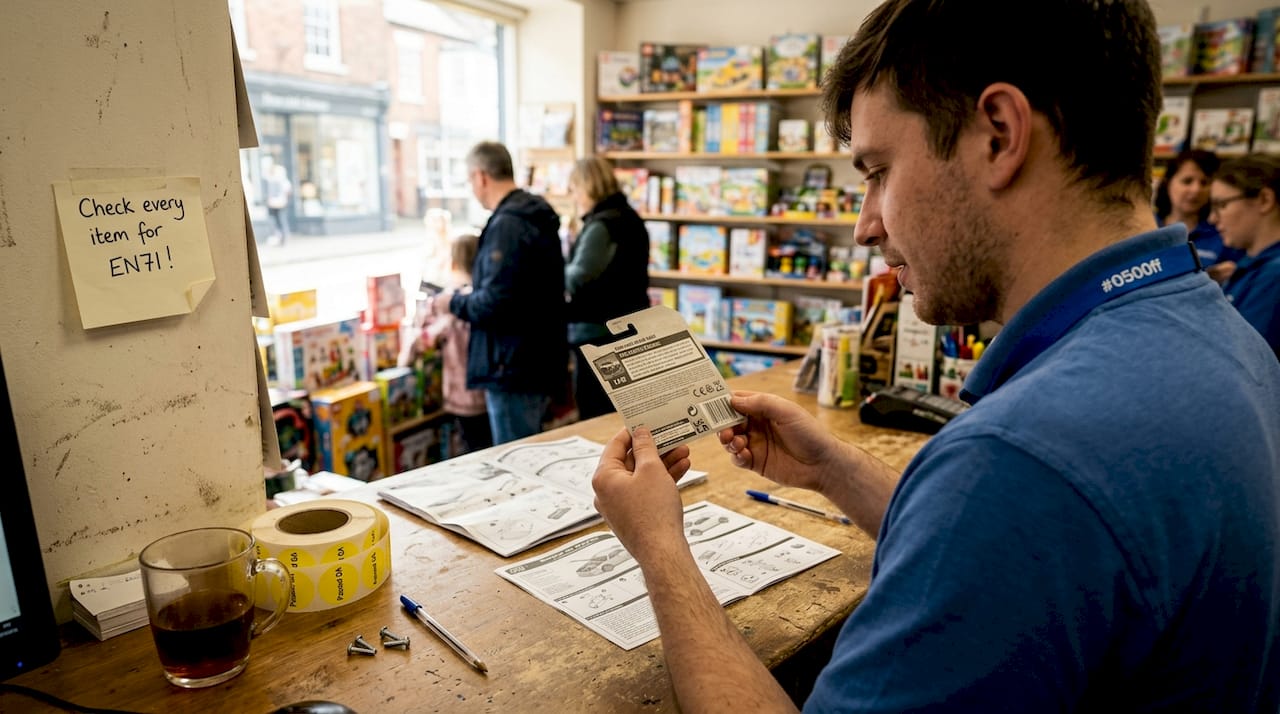
Here’s a quick reference table for the core EN71 categories you need to know:
| EN71 Part | What it covers | Why it matters |
|---|---|---|
| Part 1 | Mechanical and physical properties | Sharp edges, small parts, choking hazards |
| Part 2 | Flammability | How quickly materials catch fire |
| Part 3 | Migration of elements | Chemical safety in paints and coatings |
| Part 9 | Organic chemical compounds | Solvent and plasticiser limits |
| Part 13 | Olfactory/gustative toys | Safety for scented and taste-based toys |
Now for the number that should make every retailer sit up: only 10% of toys sourced from online marketplaces pass EN71 and BTHA testing. Ten percent. That means nine out of ten toys bought from unverified online sources could be putting children at risk.
When sourcing from any supplier, always ask for:
- A valid Declaration of Conformity
- EN71 test reports from an accredited third-party laboratory
- Evidence of UKCA or CE marking with correct placement on packaging
- The manufacturer’s registered address and responsible person details
- Batch traceability records
If a supplier can’t provide these documents promptly, that hesitation tells you everything you need to know.
How to evaluate toy safety and suitability
With an understanding of legal standards, you can now apply a methodical safety and suitability check to each toy under consideration. Think of this as your pre-order ritual, not a box-ticking exercise.
- Read every label carefully. Age recommendations, warnings, and country of manufacture must all be clearly printed in English. Vague or translated-only labels are a red flag.
- Confirm the UKCA or CE mark is present and correct. It should appear on the toy itself, not just the outer box. If it’s only on outer packaging, that’s not compliant.
- Assess the physical design. Run your hands over it. Are there sharp edges, loose parts, or pieces small enough to pose a choking hazard? Would a child bite it, swallow it, or poke it somewhere dangerous?
- Apply the age-appropriate selection tips for under 3s specifically. This age group is especially vulnerable. No small parts, no choking hazards, flame-resistant fabrics, non-toxic materials, low-volume electronics, and securely enclosed batteries are non-negotiable.
- Check battery compartments. They must require a tool or two steps to open. Button batteries are particularly dangerous and should be inaccessible to young children without adult intervention.
- Test for physical integrity. If you can get a sample, drop it from a metre height onto a hard floor. If it shatters into sharp fragments, it fails. Flex any fabric parts. Tug attached components firmly.
- Check flammability. Soft toys, dress-up costumes, and fabric items must meet flame-resistance requirements under EN71 Part 2. This matters even more at events with candles or outdoor heating.
For a broader retailer perspective on toy quality, it’s worth considering not just safety but genuine play value too.
“The safest toy is one that has been tested, certified, and genuinely designed with children in mind, not just priced to shift.”
Pro Tip: Always request sample units from your supplier before committing to a bulk order. Ask specifically for their most recent EN71 test report and check the date. Reports older than three years may not reflect current standards.
Common pitfalls and safety risks to avoid
By applying these checks, you’ve started to reduce risk. Now let’s look at what not to do, because the data here is genuinely alarming.
The British Toy and Hobby Association (BTHA) ran independent tests on toys bought from online marketplaces. The findings were stark. 81% failed EN71 mechanical and chemical tests, with 9% failing on labelling alone. The risks weren’t minor either. Choking hazards, burn risks, and chemical exposure were all identified. These weren’t niche or unusual products. They were the sort of items you’d see on a market stall or in a party bag.
Here’s a comparison to help you see the difference between compliant and risky sourcing at a glance:
| Factor | Reputable UK supplier | Unverified online marketplace |
|---|---|---|
| UKCA/CE documentation | Readily available | Often missing or forged |
| EN71 test reports | Third-party accredited | Self-certified or absent |
| Batch traceability | Yes | Rarely |
| Recall monitoring | Proactive | None |
| Labelling in English | Always | Frequently poor or translated |
The most common safety failures to watch for include:
- Small parts. Toys that break apart easily, releasing pieces smaller than 3.17cm diameter, pose choking risks for children under 3.
- Button batteries. Unsecured coin cells can be swallowed and cause serious internal burns within hours.
- Toxic materials. Cheap paints and coatings may exceed permitted limits for lead, cadmium, or phthalates.
- Poor or missing labelling. If the age warning, manufacturer details, or CE/UKCA mark are absent, the toy is non-compliant regardless of other qualities.
- Unbranded imports. These frequently bypass the regulated supply chain entirely.
Older toys also carry hidden risks. A toy manufactured a decade ago may have been compliant then but would fail today’s stricter chemical migration limits. Lead, for instance, was permitted in certain coatings under older standards. Always verify that any legacy or second-hand stock meets current EN71 requirements.
For practical guidance on improving store safety practices and broader B2B toy sourcing guidance, both resources are worth bookmarking before your next order cycle.
Final checklist for bulk purchases and events
After highlighting key safety risks, the most practical next step is an actionable, all-in-one checklist you can print and keep close at ordering time. This is the one to stick on the noticeboard in the stockroom.
Before placing a bulk order:
- Confirm UKCA or CE mark is present on each individual toy and on its packaging
- Request the supplier’s Declaration of Conformity and EN71 test reports
- Check EN71 compliance rates and verify the test report date aligns with current 2026 standards
- Order samples before committing to full quantities
- Run physical integrity, flammability, and battery compartment checks on samples
- Verify there are no open product recalls on chosen lines (check via OPSS product safety alerts)
- Confirm age labelling matches your intended event audience
- Review chemical compliance for any painted, scented, or taste-based items
For events specifically:
- Factor in crowd size: larger events mean more handling and more wear on toys before they even reach a child
- Consider weather: outdoor summer fairs mean UV exposure and heat, which can affect plastics and painted surfaces
- Plan for disposal: some novelty toys are single-use. Make sure your venue has appropriate waste facilities
- Match age ranges to stall activities: don’t place toys with small parts on a stall accessible to toddlers
- Communicate your safety checks visibly to parents. A simple sign saying “All toys CE/UKCA marked and safety tested” builds enormous trust fast
Pro Tip: Before every new order, even from a supplier you’ve used before, ask for updated safety documentation. Standards change, batches change, and suppliers sometimes switch manufacturers without notice. Making this a condition of every order protects you every time.
For support in working with reputable suppliers and a practical toy stall setup checklist specifically for event vendors, both are genuinely useful reads.
A retailer’s perspective: Beyond compliance, why safety is your brand
Let’s be honest. Most retailers treat safety compliance as a hurdle to clear, not a story to tell. That’s a missed opportunity. When you go beyond the minimum, when you train your staff to spot a dodgy label, when you explain to a curious parent exactly why your toys are certified, you’re not just ticking boxes. You’re building something that price alone can never buy: trust.
One safety incident, just one, can undo years of goodwill. A child injured by a toy from your stall doesn’t just create a legal problem. It creates a community story that travels fast, especially in the age of local Facebook groups and WhatsApp chains. The consequences are swift and disproportionate.
On the flip side, a retailer known for visible, consistent safety checks becomes the go-to. Parents remember. Schools remember. Event committees remember. Your retail safety practices become your differentiator in a crowded, competitive market. Safety isn’t just compliance. It’s your brand.
Find safer, more compliant wholesale toys with TC Toys
For those seeking vetted, safety-first toy supply for events or bulk retail, TC Toys streamlines the sourcing process. Every product we supply is CE/UKCA marked and safety tested, giving you one less thing to worry about when you’re knee-deep in event planning.
Browse our range of bulk party bag toys for filler ideas that are compliant and crowd-pleasing. Planning a school fair or community event? Our event-ready PTA toys are selected with exactly those settings in mind. And for market stall operators, our toys for market stalls range offers wholesale pricing with full safety traceability. You’ve got this, and we’ve got the stock to back you up.
Frequently asked questions
What is the UKCA mark and why is it important for retail toys?
The UKCA mark confirms that a toy meets all essential UK safety standards, and it is mandatory for toys sold in Great Britain. Without it, the toy is technically non-compliant and should not be placed on sale.
How can retailers check if a toy is safe for children under 3?
Look for clear age labelling, confirm there are no small parts or choking hazards, and ensure the toy carries UKCA or CE certification along with evidence of EN71 compliance from an accredited laboratory.
Why should retailers avoid sourcing toys from some online marketplaces?
Because 90% of toys tested from online marketplaces by the BTHA failed safety standards for mechanical and chemical compliance, posing real risks of choking, burns, and chemical exposure to children.
What are the must-have steps on a retail toy selection checklist?
Read labels thoroughly, confirm UKCA or CE certification, conduct physical integrity tests on samples, check for current recalls, and only place bulk orders with suppliers who provide current EN71 documentation on request.