

TL;DR:
- UK toy safety regulations require conformity documentation and proper markings for bulk novelty toys.
- Inspection of stock upon arrival is essential to ensure safety and compliance.
- Building strong supplier relationships and ongoing quality checks protect reputation and legal standing.
Sourcing novelty items in bulk sounds straightforward until something goes wrong. A shipment arrives without proper documentation. A batch of toys fails an age suitability check. A market stall gets pulled up by trading standards. Any one of these scenarios can damage your reputation, eat into your margins, and leave you with stock you simply cannot sell. Whether you’re planning a children’s party, running a market stall, or stocking shelves for resale, the stakes in bulk novelty procurement are higher than most people expect. This guide walks you through every step, from understanding UK regulations to inspecting your stock on arrival, so you can buy with confidence every single time.
Table of Contents
- Understanding the UK rules for novelty item procurement
- Preparation steps: What to check before you buy
- Sourcing and inspecting your novelty items
- Troubleshooting and avoiding common mistakes
- The reality of sourcing novelty items: what most guides miss
- Find reliable UK novelty items and party supplies with TC Toys
- Frequently asked questions
Key Takeaways
| Point | Details |
|---|---|
| Know UK toy safety law | All toys for children under 14 must comply with the Toys (Safety) Regulations 2011 and show documentation. |
| Check compliance evidence | Request product-specific EN 71, CE, or UKCA certificates before buying any novelty items in bulk. |
| Inspect every batch | Always inspect deliveries for hidden faults, missing marks, and unsafe features before distribution. |
| Do not resell unsafe goods | Remove or destroy any items with faults or missing compliance proof—they should never be distributed. |
Understanding the UK rules for novelty item procurement
Before you even think about placing an order, you need a firm grip on what the law actually requires. This isn’t about paperwork for the sake of it. It’s about protecting yourself, your customers, and the children who’ll end up playing with these products.
In the UK, toys intended for children’s play must meet the Toys (Safety) Regulations 2011 and demonstrate conformity through appropriate testing and documentation. This is the baseline. There’s no wiggle room here, and “I didn’t know” is not a defence that will satisfy trading standards or protect you from enforcement action.
The EN 71 standard suite sits at the heart of UK toy safety, covering mechanical and physical testing, flammability, and chemical migration. These aren’t abstract laboratory concepts. They’re the practical measures that determine whether a toy will splinter into dangerous shards, catch fire, or leach harmful substances. Knowing which parts of EN 71 apply to your specific product is essential.
Here’s a quick reference for what you need to look for on documentation and packaging:
| Document or marking | What it means | Who is responsible |
|---|---|---|
| Declaration of Conformity | Legal evidence the product meets UK/EU toy safety rules | Manufacturer or importer |
| CE mark | Conformity mark valid for Northern Ireland and some UK contexts | Manufacturer |
| UKCA mark | GB conformity mark required for England, Scotland, and Wales | Manufacturer or importer |
| EN 71 test report | Technical evidence of specific safety tests passed | Manufacturer/testing lab |
| Age warning label | Required for toys with hazards specific to age groups | Manufacturer |
Retailers and event planners are not simply passive buyers in this chain. You carry responsibility too. If you import directly, you take on the importer’s obligations. If you buy from a UK wholesaler, you’re still expected to carry out reasonable due diligence. Ignorance of these responsibilities won’t shield you if something goes wrong.
So how do you tell if a novelty item is legally classified as a toy? The key question is whether it’s designed or intended for use in play by children under 14. Decorative items, collector’s pieces, and adult novelties can fall outside the scope, but if there’s any realistic chance a child will play with it, treat it as a toy and apply the rules accordingly. Use our toy selection checklist to help you make that call quickly and confidently.
Important: Just because a product is labelled as a “novelty” or “joke item” does not automatically exclude it from toy safety regulations. If it looks like a toy and children will use it as one, the regulations apply.
Understanding good retail toy criteria from the start saves you from costly surprises later. Get this foundation right and everything else becomes much simpler.
Preparation steps: What to check before you buy
Armed with regulatory basics, here’s how to prepare before placing your first bulk order. Think of this stage as building your shield. The more thorough your pre-buying checks, the fewer headaches you’ll face once the stock lands.
Start by verifying that your supplier can actually demonstrate compliance, not just claim it. Verifying safety marking and age suitability on packaging, checking for faults and loose detachable parts, and using age warnings as risk signals are all standard practice. Do this before you commit to a purchase, not after.
Here’s how UKCA and CE marks compare for UK buyers:
| Feature | CE mark | UKCA mark |
|---|---|---|
| Valid for Great Britain? | Transitional period ended | Yes, required |
| Valid for Northern Ireland? | Yes | No |
| Issued by | EU-recognised body | UK-recognised body |
| Post-Brexit relevance | Limited for GB market | Primary mark for GB |
Knowing this distinction matters enormously when you’re buying at scale. A supplier offering only CE-marked stock may not be giving you what you need for your GB market customers.
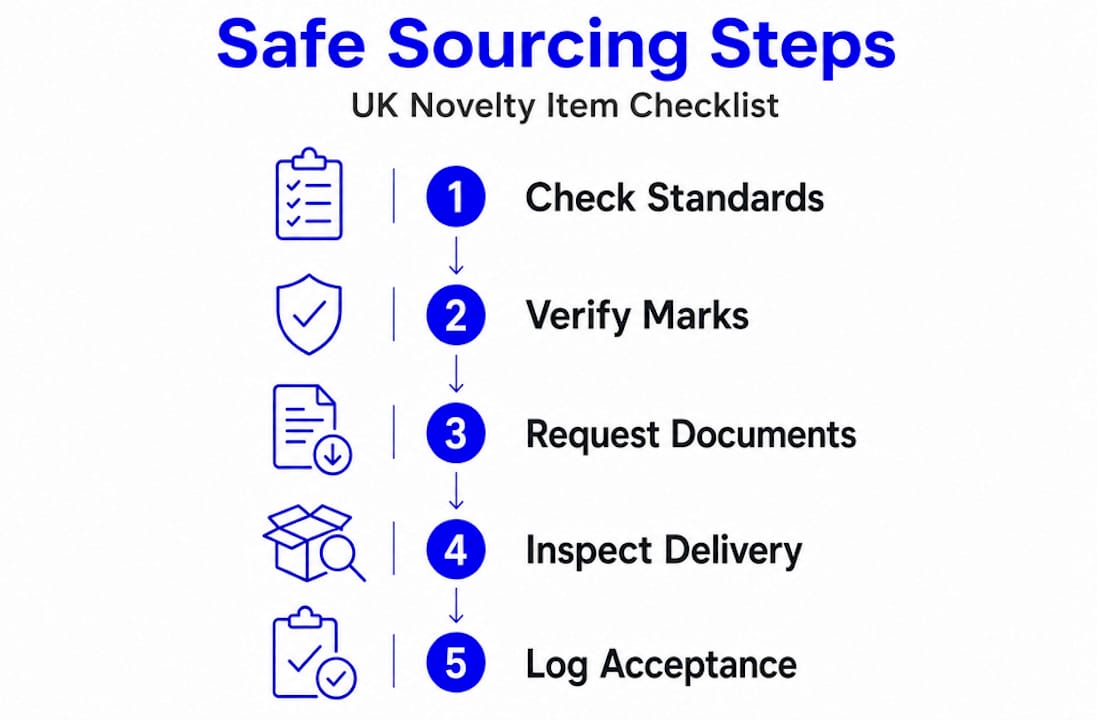
Pro Tip: Don’t accept vague or generic compliance claims. Avoid assuming “EN 71 tested” covers your specific product variant. Ask your supplier for the exact test report, the scope of what was tested, and the age grading it covers. A reputable supplier will provide this without hesitation.
Follow these preparation steps before placing any bulk novelty order:
- Request the Declaration of Conformity for every product line, not just for the category.
- Check the age grading on packaging and confirm it matches your intended audience.
- Verify the correct conformity mark for your market. GB retailers need UKCA.
- Ask for EN 71 test reports and check which specific sub-standards have been tested.
- Review the product for known risk factors: small detachable parts, button batteries, strong magnets, and flammable materials.
- Confirm the supplier holds product liability insurance and can name you as additional insured if required.
- Check your supplier’s returns and recall policy in writing before ordering.
If you’re new to bulk buying, our B2B toy market guide walks you through the full landscape. For market stall operators in particular, the market stall toys guide covers the specific considerations you’ll face at outdoor events. And if affordability is a priority, which it usually is when buying in volume, our affordable toys guidance shows you how to balance price with genuine safety standards.
Sourcing and inspecting your novelty items
Once prepared, it’s time to source your products. Here’s how to ensure every batch is safe and event-ready. Receiving a delivery is not the end of the process. It’s the beginning of your quality gate.
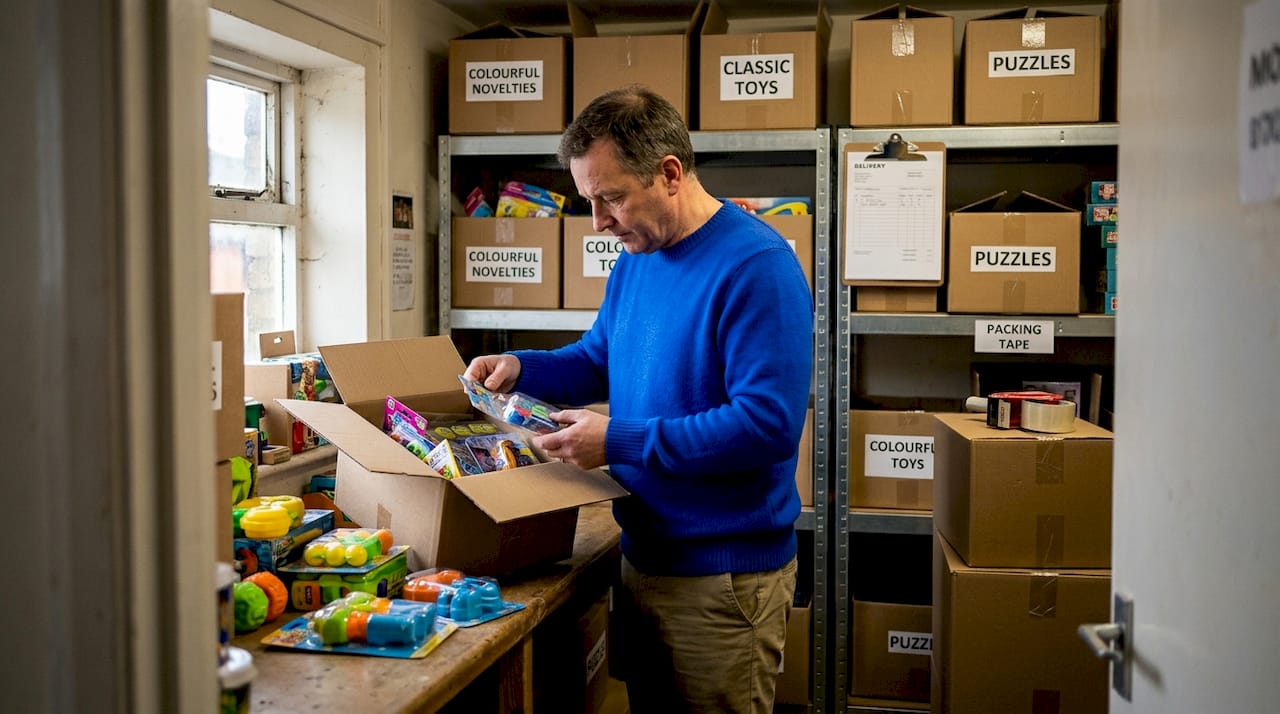
When your stock arrives, don’t just stack it in the back room and assume it’s fine. Even well-documented products can arrive damaged, mislabelled, or with missing components. A proper inspection process protects you legally and practically.
Inspect incoming lots for physical damage, easily detachable parts, battery compartment security, and magnet and battery hazards. Remove any item that fails this check rather than attempting to resell or donate it. Passing on unsafe stock, even with good intentions, can still constitute a legal offence.
Follow this inspection process for every delivery:
- Open and examine a sample from each case rather than spot-checking only top layers.
- Check all visible markings including age warnings, conformity marks, and manufacturer details.
- Test mechanisms and moving parts for sharp edges, excessive force, or instability.
- Inspect battery compartments to ensure they are secure and require a tool to open.
- Check for loose small parts that could detach under normal play conditions.
- Examine packaging integrity to ensure warnings and instructions are legible and present.
- Compare the delivery against the original product specification you received from the supplier.
Red flags to watch for during inspection:
- Items that rattle unexpectedly, suggesting internal breakage
- Battery covers that open without resistance or tools
- Magnets that are accessible or appear loosely mounted
- Packaging with foreign-language-only warnings or no warnings at all
- Items that look visually different from what was originally sampled or photographed
Pro Tip: Keep a lot acceptance log. Record the delivery date, batch number, product lines received, sample size inspected, and the outcome of your inspection. Take photographs of any defective items before setting them aside. This documentation protects you if there’s ever a dispute with the supplier, an insurance claim, or a visit from trading standards.
For deeper reading on why smart sourcing decisions directly affect your bottom line, the toys for resale insight article is well worth your time. If you’re setting up a toy stall at a fair or event, the toy stall step-by-step guide offers brilliant practical advice alongside the compliance basics.
Troubleshooting and avoiding common mistakes
Even with good processes, issues can arise. Here’s how to handle and anticipate common pitfalls before they become genuine problems.
The most frequent mistake we see retailers and event planners make is accepting blanket compliance claims without verification. A supplier might say “all our toys are EN 71 tested” and genuinely believe it. But verifying safety marking and age suitability on actual packaging, checking for faults and loose detachable parts, and treating age warnings as hard signals are steps you must take yourself. Trusting words without evidence is how problems slip through.
Common pitfalls to watch for:
- Missing or incomplete Declarations of Conformity: Don’t accept verbal assurances. If the paperwork isn’t there, the product isn’t ready to sell.
- Ambiguous age grading: Products labelled “suitable for all ages” or with no age grading are a red flag. Every toy needs a clearly defined age suitability.
- Foreign certification marks only: CE and UKCA are the marks that matter in the UK. Seeing only a mark from a non-recognised testing body is not acceptable evidence of compliance.
- “Tested to EN 71” without specifying which parts: EN 71 has many sections. Knowing a product passed mechanical testing doesn’t tell you about chemical migration or flammability.
- Reselling or donating recalled or non-compliant items: This is a serious mistake. Continuing to sell or give away items you know to be non-compliant can result in enforcement action, fines, and in serious cases, prosecution.
Critical reminder: If you cannot verify compliance, do not sell the product. Full stop. No amount of profit from a cheap bulk lot is worth the reputational and legal risk of placing unsafe items in the hands of children.
Our wholesale novelty sourcing guide goes further into building a reliable supply chain from scratch, which is particularly useful if you’re scaling up your event or retail operation.
The reality of sourcing novelty items: what most guides miss
Now let’s zoom out and consider what even detailed checklists can overlook in the real world of novelty item procurement. Because here’s the honest truth: paperwork is a starting point, not a finish line.
We’ve seen retailers work through every compliance step correctly and still end up with a batch of toys that feel wrong the moment they’re handled. Cheap plastic that snaps too easily. Painted surfaces with an odd smell. A mechanism that works fine in isolation but fails after a few dozen uses. None of these issues are captured on a Declaration of Conformity. They’re caught by people who know what good quality feels like and who have built enough of a relationship with their supplier to push back when something isn’t right.
That’s the thing most guides gloss over. Supplier relationships matter enormously in bulk procurement. A supplier who knows you take quality seriously will take your orders more seriously. They’ll flag issues proactively. They’ll replace faulty stock quickly. They’ll send you documentation without you having to chase it three times.
Regulatory compliance is the floor, not the ceiling. The ceiling is the trust your customers and event attendees place in you when they buy a toy from your stall or pull a novelty item from a party bag. That trust is built not by paperwork but by consistent quality over time.
There’s also a commercial reality here that many buyers underestimate. Cheap stock that fails quickly damages your reputation far more than the money you saved on the unit cost. Why cheap toys attract customers is a genuinely useful angle to understand, but only when “cheap” means affordable rather than low quality. The best bulk buyers understand this distinction instinctively.
Treat safety and quality as ongoing processes. Review your suppliers regularly. Update your checklists as regulations evolve. And never let the pressure of a deadline push you into skipping an inspection step. You’ve built something worth protecting.
Find reliable UK novelty items and party supplies with TC Toys
With your procurement process optimised, you can now source reliably, and we’d love to make that easier for you.
At TC Toys, every product is CE or UKCA marked and safety-tested, so you’re not starting from scratch on compliance. Our bulk party bag toys are perfect for event planners and party organisers who need reliable, fun stock in quantity without the compliance guesswork. Running a fairground stall or market event? Our stall fairground toys collection is built exactly for that. And if you want to add that extra finishing touch, our mini paper party bags are a crowd-pleasing addition to any gift or goodie bundle. Fast UK delivery, no minimum order, and wholesale pricing across the board. Easy.
Frequently asked questions
What is the difference between CE and UKCA marks on novelty items?
Both marks indicate safety compliance, but UKCA is specific to Great Britain and is required for toys sold in England, Scotland, and Wales, while CE remains relevant for Northern Ireland.
Are all novelty items covered by UK toy regulations?
Only novelty items intended for children’s play are classified as toys. Those items must meet the Toys (Safety) Regulations 2011 and carry the appropriate conformity documentation.
What are the most common safety failures to check for in bulk novelty toys?
Inspect for physical damage, detachable parts, unsecured battery compartments, and accessible magnets, as these are the most frequently identified hazards in bulk novelty toy deliveries.
Can you sell bulk novelty toys in the UK without product documentation?
No. Importers must retain conformity documentation and make it available if requested, as selling without this evidence risks enforcement action, product recalls, and fines.